


Shopify AI Search Visibility Audit: 10 Things to Check Before Optimizing for AI Tools Like ChatGPT
Online shopping is changing. Customers no longer rely only on Google to search for products. Modern customers now ask AI tools like ChatGPT, Gemini, Grok, Claude, etc for recommendations, product comparisons, buying advice, and solutions to everyday problems.
For Shopify store owners, this change creates a new opportunity to help their customers find products through AI-powered search and recommendation experiences. But it also creates a challenge. SEO alone is no longer enough. Your store needs product information, useful content, a technically accessible website, consistent brand details, and a strong foundation in traditional search engine optimization. AEO (Answer Engine Optimization) and GEO (Generative Engine Optimization) help make your content easier for AI-powered search and answer engines to understand, discover, and potentially cite in their responses.
A well-planned Shopify AI search visibility strategy will allow you to evaluate whether your store is prepared for this changing discovery landscape. Read this blog to get details about what to check and who to hire to build an effective SEO, AEO, and GEO strategy.
Why AI Search Visibility Matters for Shopify Stores
AI-based search engines have changed the way people shop and make buying decisions. Now, instead of looking at different products on various websites, consumers can ask a question and receive a simple response or comparative information in a matter of minutes.
For example, someone looking for skincare products will directly ask ChatGPT to recommend brands based on ingredients, budget, skin concerns, and customer reviews. This makes ChatGPT product visibility important. If your Shopify store has relevant, accurate, and accessible information, your products will appear in these discovery experiences.
Improving Shopify AI search visibility matters for three main reasons.
- First, it creates additional discovery opportunities. Customers may discover your brand through AI-generated answers if you have done correct Shopify AI SEO for your store.
- Secondly, it enables more informed purchasing decisions. The detailed specifications of products, together with the transparent policies and useful guides for buying products, make it difficult for consumers not to understand all the advantages of your shop.
- Thirdly, it enhances the effectiveness of your larger digital marketing campaigns. Numerous factors that ensure effective AI search optimization for Shopify, also are good for traditional SEO and CRO.
However, AI recommendations are not always guaranteed. But for ChatGPT product visibility, improving your store’s accessibility and content quality can put your business in a stronger position as search behavior evolves.
Why AI Search Visibility Matters for Shopify Stores
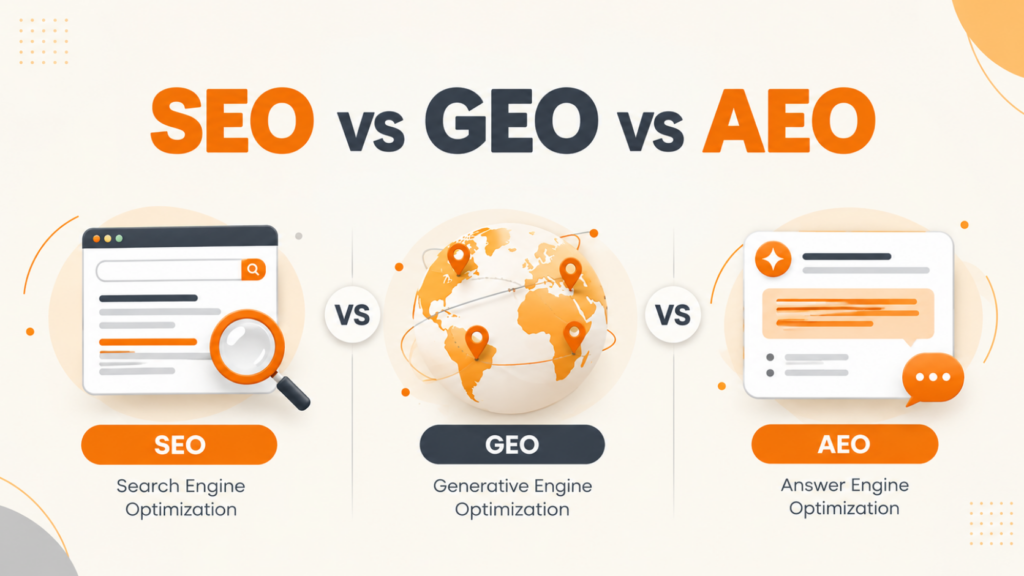
SEO, AEO, and GEO work toward a related goal: helping customers find and understand your brand. However, each focuses on a different aspect of discovery.
| Strategy | What it means | Main objective |
| SEO | Search Engine Optimization | Improve visibility in traditional search engines such as Google. |
| AEO | Answer Engine Optimization | Make your content useful and accessible for direct answers to customer questions. |
| GEO | Generative Engine Optimization | Improve how generative AI systems discover, interpret, and potentially reference your content. |
SEO (Search Engine Optimization) helps your Shopify store appear in Google search results. It includes using relevant keywords, improving website speed, creating quality content, and building links from trusted websites.
Example: Helping your product page rank when someone searches for “best running shoes.”
AEO (Answer Engine Optimization) focuses on answering customers’ questions clearly. You can do this by adding useful FAQs, detailed product descriptions, and comparison pages that address common customer concerns.
Example: Providing a clear answer to “Which running shoes are best for beginners?”
GEO (Generative Engine Optimization) focuses on helping AI tools like ChatGPT understand your brand and products. Clear product information, consistent brand details, and mentions on trusted websites can help AI systems understand and potentially recommend your products.
Example: Helping ChatGPT understand your products when someone asks for running shoe recommendations.
Together, these approaches support a comprehensive Shopify AI SEO strategy. This is not a replacement for traditional SEO; Shopify merchants should build on their existing search foundations while adapting content to conversational and generative search experiences.
Why AI Search Visibility Matters for Shopify Stores

Before making any changes on your website, check these ten areas to identify gaps to improve visibility on search engines and AI platforms.
1. Review Your Product Titles and Descriptions
Your product pages should clearly explain what you sell, who the product is for, and why customers should choose it. Include product details such as:
- Product type, materials, size, color, and specifications.
- Target customers, use cases, and key benefits.
- Compatibility, care instructions, or limitations where relevant.
For example, if you sell T-shirts, add “Organic Cotton Oversized T-Shirt for Everyday Wear.” This helps customers and AI systems understand your products.
2. Check Your Shopify Store’s Crawlability
Search engines and AI tools require pertinent information in order to recognize your products. Verify the contents of your robots.txt file, XML sitemap, canonical tags, and the URLs of vital web pages. Make sure that pages containing data on products, collections, and general information are reachable, and check the impact that JavaScript may have on your site’s accessibility. Each AI service utilizes its own ways of finding information, so do not think that one scientific solution can be effective in every case.
3. Implement Relevant Structured Data
Structured data enables search engines and AI tools to comprehend data concerning your products. In particular, the relevant product schema for Shopify stores includes the following types of information: Product name, images, prices, availability, brand description, and review information. You need to check the validity of your code with Google’s Rich Results Test and ensure that the markup corresponds to the content already visible on your pages. Accurate structured data supports machine readability but does not guarantee AI recommendations.
4. Optimize Product Pages for Customer Questions
Customers often ask AI tools questions and need detailed answers before purchasing. Make your product pages answer questions such as:
- What problem does this product solve?
- Who is it best suited for?
- How does it compare with alternatives?
- What materials or ingredients does it contain?
- How should customers use or maintain it?
5. Strengthen Your Brand’s Online Presence
AI-powered discovery can draw on information beyond your website. If you maintain consistent brand details across your website, business profiles, reputable directories, and relevant industry platforms, it will strengthen your brand presence. Ask your customers to share reviews, seek relevant editorial mentions, and publish useful content that shows your expertise.
6. Create Helpful Buying Guides and Comparison Content
Product pages may not have the answers to every question customers have while they are buying something. You can make:
- Buying guides and product comparisons.
- Product care and maintenance articles.
- FAQs about shipping, sizing, and compatibility.
- Educational content addressing common customer problems.
This helps them understand your product. For example, if you have a running shoe store, you make comparison guides of shoes for beginners, long-distance runners, and everyday use. Such content can improve ChatGPT product visibility by providing additional context about your products.
7. Improve Internal Linking and Site Structure
Organize products into relevant collections and connect related pages through descriptive internal links. A clear structure might follow this path:
Homepage → Product category → Relevant collection → Individual product
You can also display a collection instead of a category. Items that a buyer is looking for can be linked to relevant products, while corresponding articles can be interconnected. A good structure eases navigation for users and helps them discover content where needed.
8. Audit Reviews, Trust Signals, and Policies
Customers need confidence in your brand before purchasing. Add trust signals and check them:
- Authentic customer reviews and testimonials.
- Clear shipping, return, and refund policies.
- Accurate contact information and transparent pricing.
- Secure checkout and detailed product specifications.
- Warranty information where applicable.
9. Test Your Store Across AI Search Experiences
Optimized stores will not guarantee Shopify store visibility in ChatGPT and other AI platforms. You should ask questions that are relevant to your target audience, including product searches, recommendations on product categories, and product comparisons. Make sure to track mentions of your brand, mentions of competitors, accuracy of products, and cited references, if they are available. This will help you track the visibility of Shopify’s AI search capabilities and narrow down any content gaps.
10. Measure Traffic, Engagement, and Conversions
Visibility is important because it is a critical element in the performance of your Shopify store since it helps pull in relevant visitors that enable sales. Use tools such as Google Search Console, Google Analytics 4, and Shopify analytics to keep track of organic traffic, impressions, clicks, engagement, and conversions. Track AI referral traffic separately wherever possible and monitor the success of products over time. Always set one benchmark prior to optimizing, and analyze the results every month.
How SEO and CRO Turn Visibility Into Sales
While visibility sounds interesting, it does not ensure sales. A potential customer must have a clear understanding of the product, be assured of the reliability of the brand, and be able to make a purchase without difficulty once they reach your website.
This is where SEO and conversion optimization come in. SEO helps the right people to find your store by utilizing various techniques to improve search relevance, technical accessibility, and content quality, while CRO aims to streamline the shopping process through easy navigation, strong calls to action, and quick page loading times.
For example, a customer discovers a product through an AI-generated recommendation and visits your Shopify store to check it. If the product page lacks information they need, shipping details, or clear images, the customer will leave without purchasing. Improving Shopify AI SEO elements will make their experience helpful and bring you sales. A comprehensive Shopify AI search visibility strategy should therefore measure not only discovery but also the quality of the traffic generated and its contribution to revenue.
How Mandasa Technologies Helps Shopify Stores Grow With SEO, AEO, and GEO
Now that shoppers are turning to AI platforms for product recommendations. If your store isn’t showing up in the answers they need, it means you are missing opportunities to reach your customers. The 10 things above may seem easy when you read them, but when applying them, you might not be able to fulfill everything. Our AI search optimization for Shopify services will help you adapt to this shift with:
AEO: Get Your Products in the Answers
Answer Engine Optimization positions your brand and products for customer-related queries. We create product descriptions, FAQs, buying guides, and other useful content that shoppers use while asking artificial intelligence applications what to purchase.
GEO: Improve Your Visibility Across AI Platforms
Generative Engine Optimization improves the ease with which both AI systems can find the store’s content and interpret and offer it to users. This covers the areas of content structure, item details and descriptions, structured data, and technical accessibility.
SEO + CRO: Turn Visibility Into Sales
By merging traditional SEO with conversion optimization, we improve Google visibility and enhance the shopping experience. We handle every aspect of SEO, from technical optimization to keyword analysis and product page enhancement to seasonal landing page development and sales campaign optimization.
Conclusion
With the rise of AI-enabled search, Shopify merchants are presented with exciting opportunities, but a successful optimization process starts with a foundation. The product information needs to be accurate, the website should be accessible, the content should answer actual customer queries, and the shopping experience should help the customers make purchase decisions. A structured audit helps to identify necessary improvements before starting a more extensive optimization process.
With the use of SEO, AEO, GEO, and CRO techniques together, e-commerce merchants can create a more effective process of discovering products and making sales. The intention behind this combination is not just to optimize search engines following AI strategies for Shopify but to help the right audience understand the value of the product and find the right place to purchase it.
Contact Mandasa Technologies to see how you can improve the presence of your Shopify website in the world of ChatGPT. Get a free SEO audit before committing, and after you do, we will take care of everything.
FAQs for Shopify AI Search Visibility
1. How to optimize a Shopify store for ChatGPT?
Use clear product descriptions, correct specifications, appropriate FAQs, and well-organized data. Focus on answering customers’ queries and making the product information easy for AI tools to understand. This will help you with AI search optimization for Shopify.
2. How to improve Shopify visibility in AI search?
Ensure that your product pages are crawled more efficiently; publish guides that assist customers in buying your products, and improve your brand reputation via real reviews and credible sources. This will improve Shopify store visibility in ChatGPT, Claude, Gemini, etc.
3. How to get Shopify products recommended by ChatGPT?
Ensure that your product is well-described and that you respond to frequent inquiries about buying it while also establishing a trustworthy online identity. The initiatives mentioned here should help to enhance the ChatGPT product visibility, but it is impossible to make any promises.
4. What is a Shopify AI search visibility audit checklist?
Check product descriptions, crawlability, structured data, FAQs, brand mentions, internal links, trust signals, AI search results, and conversions. Regular audits will help identify gaps and prioritize improvements. If you are confused about what to do or where to start, hire a Shopify SEO agency like Mandasa Technologies.
5. How do AI search engines discover Shopify products?
AI platforms may use web crawling, search indexes, retrieval systems, and product feeds. Clear product information, accessible pages, and relevant content help AI systems understand your offerings and improve Shopify store visibility in ChatGPT and other AI experiences.

Leave a Reply